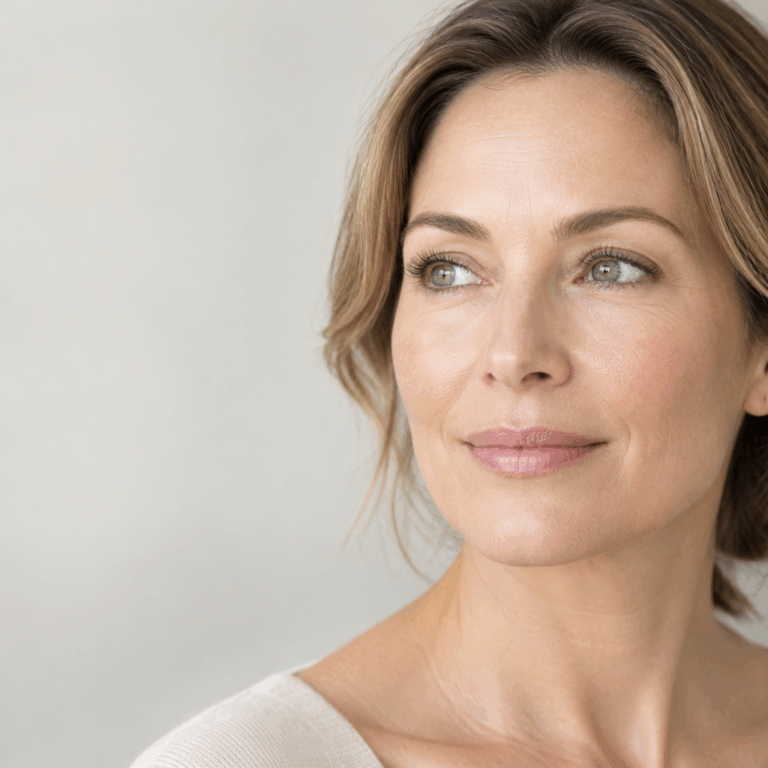
If your eyelids have started to sit heavy over your eyes, you will know the small daily frustrations that come with it. Eyeliner disappears the moment you apply it. Mascara transfers onto the lid above. Photographs show someone who looks tired or cross, even when you feel neither. And by the end of a long day of reading or driving, you may find yourself lifting your brows with your fingers just to see clearly.
This is usually caused by excess skin in the upper eyelid, a change surgeons call dermatochalasis. It is extremely common, it develops gradually, and it is one of the most rewarding things we treat at Precision Surgery in Birmingham. Upper eyelid blepharoplasty removes the surplus skin and, where needed, repositions a small amount of fat, so the eye opens freely and the face looks rested again.
In this guide we explain what causes hooded upper eyelids, when surgery is genuinely worthwhile, exactly what the operation involves, how recovery unfolds week by week, and how upper lid surgery differs from the lower eyelid procedure we have written about separately.
What Causes Hooded Upper Eyelids?
The upper eyelid is a layered structure: skin, a thin sheet of muscle called orbicularis oculi, the fibrous orbital septum, and behind that the fat pads that cushion the eye. Ageing, sun exposure and genetics all affect how those layers behave.
Loss of skin elasticity
As collagen and elastin decline, the eyelid skin, which is the thinnest in the body, loses its ability to snap back. It stretches, folds and hangs over the eyelid crease. This is the single most common cause of a hooded appearance, and it is often inherited as much as it is a product of age.
Fat prolapse and muscle laxity
The fat pads that sit behind the septum can push forward as the retaining tissue weakens, producing puffiness above the crease. Meanwhile the eyelid muscle and its attachments stretch, so the whole complex sags a little lower each year. Some patients have a combination of excess skin and bulging fat, which is why a good assessment matters more than a one-size-fits-all operation.
Brow descent
Not all heavy eyelids are caused by the eyelid itself. As the brow drops with age, it pushes skin down onto the upper lid. If the brow is the main culprit, removing eyelid skin alone can make the brows look even lower afterwards. Part of the consultation is working out how much of the problem belongs to the eyelid and how much belongs to the brow, because the answer changes the plan.
Other contributors
Fluid retention, thyroid disease, eyelid skin conditions, long-term use of some medications and previous injury or surgery can all affect eyelid appearance. If anything in your history suggests an underlying cause, we investigate or refer before considering an operation.
When Is It More Than a Cosmetic Issue?
Many patients come to us purely because they dislike what they see in the mirror, and that is a perfectly good reason to seek treatment. But heavy upper eyelids can also cause real functional problems, and it is worth knowing the difference.
When the fold of skin hangs low enough, it can physically block the upper part of your visual field. Patients describe this as a curtain coming down, particularly at the outer corner. It can interfere with reading, with driving, with judging steps and kerbs, and with the peripheral awareness that matters when you are on a busy road or in a car park. Some people develop a compensatory habit of raising the eyebrows constantly, which can cause forehead aching and headaches by the end of the day.
There are also practical skin problems. The fold traps moisture and warmth, so the skin beneath it can become chronically inflamed, itchy or infected, a condition called intertrigo. Make-up collects there, spectacles sit awkwardly, and some patients find their vision is smeared by the lid resting on the lash line.
If your eyelids are affecting your field of vision rather than just your appearance, it is worth saying so at consultation. It changes the conversation, it may be relevant to any insurance or funding question, and it means the operation is planned around restoring function as well as improving how the eyes look.
What Does Upper Eyelid Blepharoplasty Involve?
Upper blepharoplasty is a day-case procedure carried out under local anaesthetic. You are awake, comfortable and able to talk to us throughout, and you go home the same day.
Marking and planning
Before any anaesthetic, we mark the planned excision with you sitting upright, because the eyelid looks different when you are lying flat. The incision is placed in the natural skin crease, a few millimetres above the lash line, so that the scar ultimately hides in the fold. We also check brow position, eyelid closure and tear film at this stage. The amount of skin removed is deliberately conservative: too little leaves you under-corrected, but too much can prevent the eye closing properly, and that is a far more serious problem than a residual fold.
The operation
Local anaesthetic is injected into the eyelid, which stings briefly and then numbs the area completely. A fine ellipse of excess skin is removed, along with a strip of the underlying muscle where it is contributing to the heaviness. If a fat pad is bulging, a small amount is trimmed or repositioned. Bleeding is controlled with fine cautery, and the wound is closed with a running or interrupted suture of very fine thread. The procedure usually takes 45 to 90 minutes for both upper lids, depending on complexity, and many patients are surprised by how calm and painless it is.
What we do not do in the same operation
Upper blepharoplasty does not lift the brow, and it does not correct ptosis, which is drooping of the eyelid itself caused by a weak levator muscle. Those are separate procedures with separate planning. If either is present, we will tell you at consultation, because combining the wrong operations or missing a ptosis can lead to an unsatisfactory result.
Recovery Week by Week
Days one to three
Expect swelling, bruising and a tight feeling. Bruising can track down around the eye and occasionally onto the cheek, which looks dramatic but settles. Cool packs for ten to fifteen minutes at a time, several times a day, help a great deal. Keep your head elevated on two pillows and avoid bending, straining or heavy lifting. Simple painkillers are usually enough; avoid aspirin and ibuprofen unless we have specifically advised otherwise, as they increase bruising.
Days four to seven
Swelling peaks around day two or three and then improves steadily. Most patients feel presentable in sunglasses by the end of the first week. Sutures are typically removed between day five and day seven, which is quick and only mildly uncomfortable. You can shower carefully, but keep the wounds dry and clean, and do not rub your eyes.
Weeks two to four
Bruising has usually faded, though a faint yellow tinge can linger. The lids may feel tight or numb, and the scar will look pink and slightly lumpy. This is normal. Most people are back at work within seven to fourteen days, and back to gentle exercise after about two weeks, building up gradually.
Six weeks onwards
This is when the result starts to look like the final result. The scar softens, fades towards the natural crease line and becomes much less noticeable. Residual swelling continues to settle for three to six months, and the skin may feel dry or slightly sensitive for a while. We review you in clinic to check healing, eyelid closure and symmetry.
Risks, Scars and Honest Limitations
Upper blepharoplasty is one of the safest operations in surgery, but no operation is risk-free. Bruising, temporary swelling, dry eyes, small areas of numbness, slight asymmetry and a scar that stays pink for longer than expected are all common and usually settle. Less common problems include infection, a small cyst along the suture line, difficulty closing the eye fully, and the need for a minor revision.
It is also worth being realistic about what surgery can and cannot do. Blepharoplasty will not remove wrinkles, dark circles, crow’s feet or pigment changes, and it will not lift a heavy brow. What it does very well is remove the fold of skin that makes the eye look closed and tired. Patients who understand that distinction tend to be the happiest with their outcome.
There are also people for whom surgery is not the right answer. If your main concern is hollowing under the brow, or fine lines, non-surgical options may suit you better. If you have poorly controlled thyroid eye disease, dry eye syndrome or a bleeding disorder, we will discuss the risks in detail before proceeding. And if you are simply unsure, a consultation with no obligation is the right place to start.
Why Choose Precision Surgery for Eyelid Surgery?
Eyelid surgery is small in scale and unforgiving in execution. A millimetre of skin makes a visible difference, the eyes are the first thing anyone notices, and symmetry matters. At Precision Surgery in Birmingham, upper blepharoplasty is performed under consultant-led care in a clean, fully accredited environment, with careful marking, conservative tissue removal and a clear plan for aftercare.
We keep the process straightforward: a proper consultation with an honest opinion about whether surgery will help, a short procedure under local anaesthetic, written aftercare instructions, and a follow-up review to check the scar and the result. If you have previously had eyelid surgery elsewhere and are unhappy with the outcome, we also assess revision cases.
If heavy, hooded upper eyelids are making you look tired or getting in the way of your vision, help is closer than you think. Call us on 07822 002890 or fill out our contact form to book your appointment.