Finding a smooth, pea-like lump beneath your skin is a common experience, and in the vast majority of cases it turns out to be a cyst — a harmless, fluid- or keratin-filled sac that grows slowly under the surface. Cysts are among the most frequent reasons patients book a consultation at our Birmingham clinic, and while most are entirely benign, they rarely disappear on their own. Left alone, they can slowly enlarge, catch on clothing, become uncomfortable, or — frustratingly — become infected at the worst possible moment. In this guide, we explain what cysts are, the warning signs that mean a lump should be assessed promptly, why home removal attempts backfire, and exactly what private cyst removal in Birmingham involves from consultation to final scar review.
What Are Cysts and Why Do They Form?
A cyst is a closed sac that develops beneath the skin, usually filled with a soft, cheese-like material called keratin, or in some cases clear fluid. The most common types we treat include:
- Epidermoid cysts — the classic “pea under the skin”, often found on the face, neck, chest and upper back. You may have heard them called sebaceous cysts, although that older term is a misnomer: these cysts are filled with keratin, not sebum.
- Pilar (trichilemmal) cysts — firm, smooth lumps that develop on the scalp and often run in families.
- Ganglion cysts — fluid-filled swellings that appear near joints and tendons, most often around the wrist or hand.
- Infected or inflamed cysts — when the sac wall ruptures or bacteria enter, the lump becomes red, tender and painful and may discharge pus.
Cysts form when the surface of the skin turns inwards on itself, creating a pocket that keeps producing keratin. Some follow a minor injury, a blocked pore or an ingrown hair; many simply appear without an obvious cause. People in their twenties to forties are affected most often, and there is frequently a family tendency. Importantly, a cyst is not a fatty lump (that is a lipoma) and it is not a mole — although all three are commonly confused on first appearance, which is why a quick professional assessment of any new lump is worthwhile.
Warning Signs: When a Lump Should Be Seen Promptly
Most cysts are painless, slow-growing and harmless. However, a small number of features do warrant an urgent assessment, because occasionally what looks like a routine cyst turns out to be something that needs a different approach entirely. We recommend booking an appointment promptly if a lump is:
- Growing quickly — cysts typically enlarge gradually over months or years; a lump that visibly changes over a few weeks needs reviewing.
- Hard, irregular or fixed — cysts are usually smooth, rounded and freely mobile under the skin.
- Red, hot or painful — these are features of infection or inflammation, which needs treating before any definitive surgery.
- Discharging blood or pus — a recurrently discharging lump should never simply be squeezed at home.
- Associated with skin changes — ulceration, dimpling or colour change over the lump should always be seen.
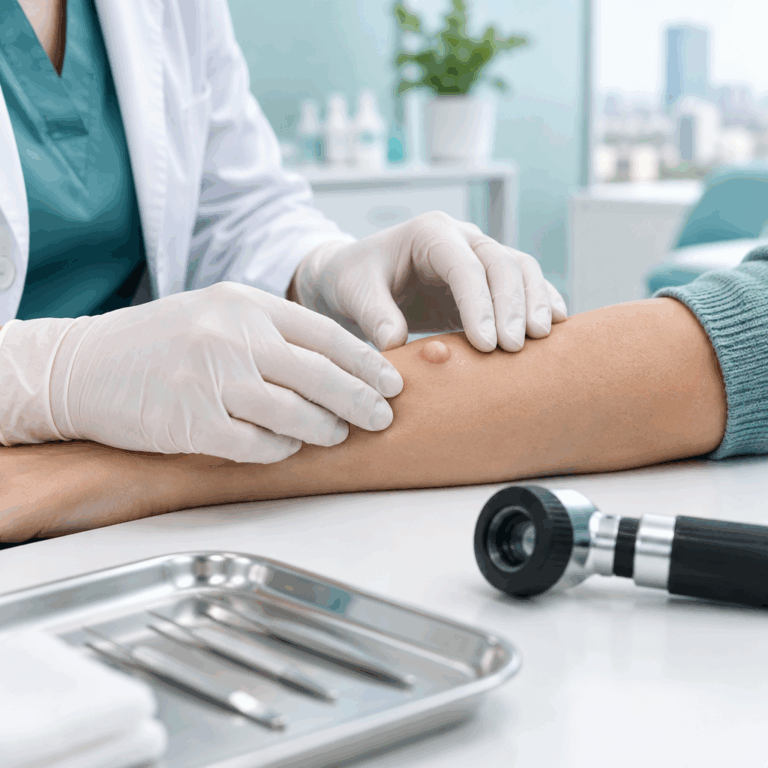
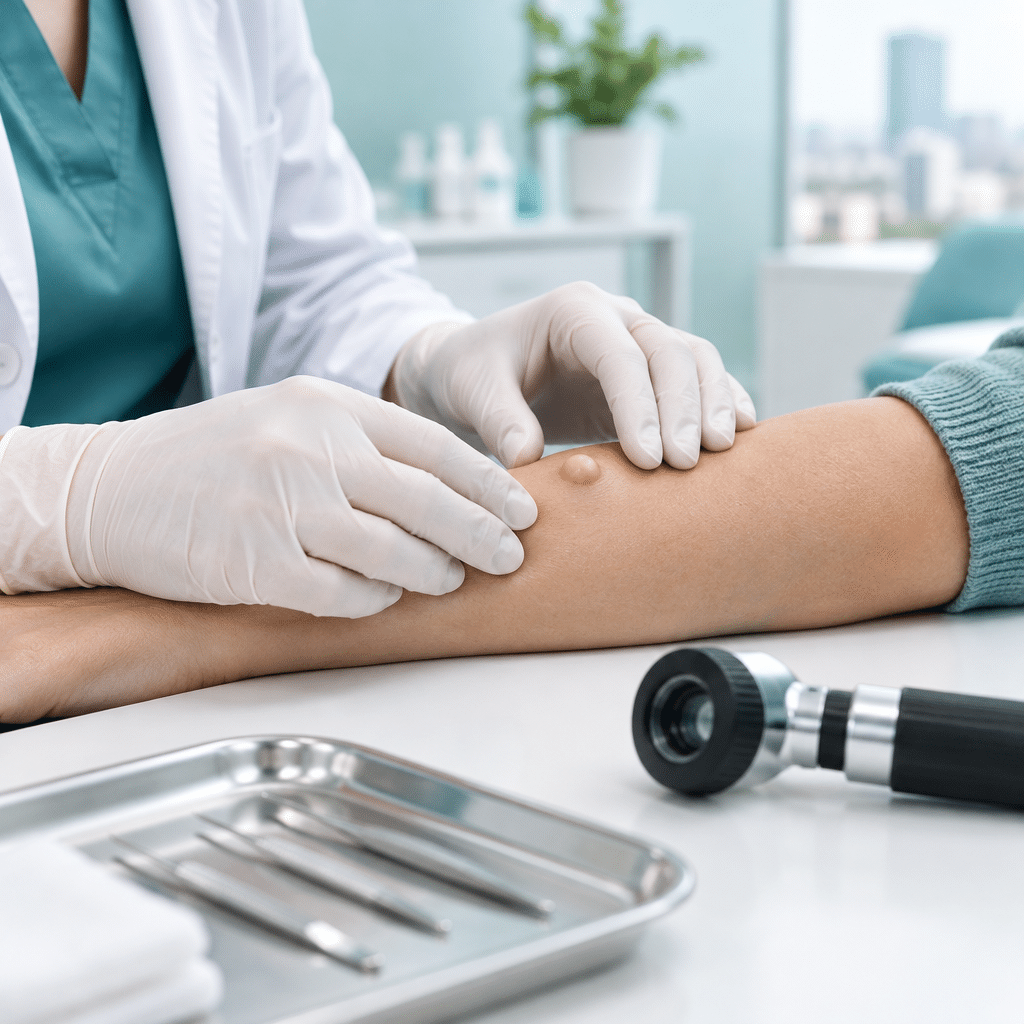
Even when none of these features is present, many patients choose to have a lump assessed simply for peace of mind. A consultation takes minutes, and an experienced surgeon can usually tell you straight away whether you are dealing with a straightforward cyst. During your assessment we will examine the lump, sometimes with a dermatoscope, and discuss the safest and simplest way to remove it.
Why Squeezing a Cyst Always Backfires
It is tempting to squeeze out the contents of a cyst at home — and some patients do, usually more than once. The trouble is that squeezing almost never solves the problem. The thick, paste-like contents reaccumulate within weeks because the sack that lines the cyst — the sac wall — is still in place, quietly continuing to produce keratin. You have emptied the tank, but left the factory running.
There are more serious drawbacks, too. Squeezing can force the contents deeper into the surrounding tissue, triggering an inflamed, painful reaction that leaves the area swollen and tender for weeks. It can also introduce bacteria and cause a genuine abscess, which may require antibiotics or emergency drainage before anything else can be done. Finally, repeated squeezing hardens and scars the tissue around the cyst, which makes later surgical excision more difficult and can leave a wider scar than would otherwise have been necessary. The definitive treatment is complete surgical removal of the cyst together with its entire sac — which is exactly what we specialise in.
What Cyst Removal Involves: From Consultation to Closure
Private cyst removal at our Birmingham clinic is a walk-in, walk-out procedure performed under local anaesthetic, so you stay awake and comfortable throughout. The process is straightforward:
Your consultation and examination
At your first appointment, your surgeon will examine the lump and confirm it is a cyst suitable for removal under local anaesthetic. This is also your opportunity to ask questions: where the scar will sit, how long the stitches stay in, and when you can return to work or the gym. If a cyst is acutely inflamed or infected on the day, we may recommend settling it down first, because operating on inflamed tissue increases the risk of the cyst returning and of a poorer scar.
The removal procedure
On the day of treatment, the skin over the cyst is cleaned and numbed with local anaesthetic — a brief sting, and then nothing more. Through a small, carefully placed incision, the surgeon gently frees the cyst from the surrounding tissue and removes it in one piece, sac and all. The wound is closed with fine stitches, many of which dissolve by themselves, and a small dressing is applied. Most cyst removals take between twenty and forty-five minutes, and once the anaesthetic wears off you can drive home and carry on with your day. If the cyst is in a cosmetically obvious position on the face, neck or scalp, we take particular care to hide the incision within natural skin creases so the final scar is as discreet as possible.
Very large cysts, cysts that have ruptured in the past, and cysts in tricky locations near the ear, eyebrow or collarbone need a little more planning, and your surgeon will discuss this with you at the consultation. In some cases, removing a long-standing cyst leaves behind a small pocket of stretched skin; the incision is designed to take up this laxity so the final contour is smooth rather than wrinkled. Children and teenagers with cysts are equally welcome, and the same gentle local-anaesthetic technique is usually suitable — we will always discuss the options that make the experience as relaxed as possible.
What happens to the cyst afterwards
It is good practice to send every removed cyst for histological analysis, where a pathologist confirms the diagnosis under a microscope. This is a routine safeguard, not a sign of concern, and you will be informed of the result.
Recovery, Scarring and Reducing the Risk of Recurrence
Recovery after cyst removal is usually quick and simple. You can shower the same day, keeping the dressing dry for the first twenty-four to forty-eight hours. Stitches on the face are typically removed within five to seven days; those on the scalp, chest or back may stay slightly longer or dissolve on their own. Most people return to office work immediately and to exercise within a week or two, depending on the cyst’s location.
Every removal leaves a scar, but there is a great deal you can do to help it settle well:
- Keep the wound clean and dry for the first couple of days, and follow the aftercare sheet provided.
- Avoid stretching the wound — sports and heavy lifting are best paused until the skin has strengthened.
- Massage and moisturise the healed scar gently from about three weeks onwards; this encourages the scar to soften and fade.
- Protect the scar from the sun for at least a year, because UV exposure darkens new scars permanently.
When a cyst is removed intact with its sac, the chance of it returning is low. Recurrence is more common after removal of previously inflamed or ruptured cysts, or after drainage procedures that leave the sac behind — another reason to have a cyst treated electively, before it ever becomes infected. Some patients, particularly those with darker skin tones, are prone to raised or keloid scars; if that applies to you, mention it at your consultation and we can plan scar management, including silicone therapy or steroid treatment, from the outset rather than after problems arise.
A final scar review appointment rounds off the journey. At this visit we check the wound has healed cleanly, confirm the histology result with you, and review the scar’s progress. If the scar is settling slowly, becoming raised or looking redder than expected, early measures such as taping, silicone gel or referral for steroid treatment can make a real difference — and they work best when started early rather than months down the line.
Book Your Cyst Removal Assessment in Birmingham
A cyst is easy to live with — until it is not. Whether yours has started to catch on your collar, you are tired of covering it with makeup or a haircut, or you simply want a professional opinion on a new lump, we can usually see you quickly at our Birmingham clinic, plan your removal, and give you a clear idea of the final result on the day. If your lump shows any of the warning signs above, do not wait for it to settle on its own: get it checked.
Call us on 07822 002890 or fill out our contact form to book your appointment. Your surgeon will assess the lump, answer all your questions, and arrange removal at a time that suits you — so the next time you run your fingers over that spot, there is nothing there at all.